Starbucks AI Inventory System Shut Down Today After 9 Months
Starbucks has ended its AI-powered inventory counting system across North America less than a year after launching it, marking one of the company’s most significant technology reversals in recent years.
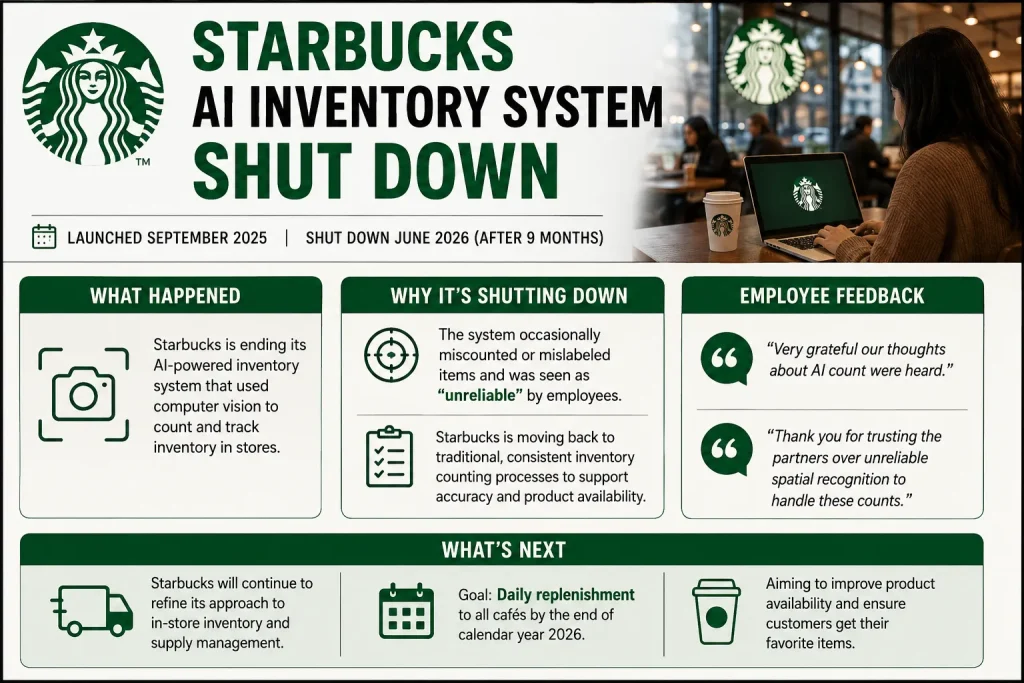
The tool, known internally as Automated Counting, was introduced in September 2025 to help stores track inventory more efficiently and reduce product shortages. However, Starbucks has now retired the system after employees reported frequent counting errors and inventory inaccuracies.
The decision highlights a growing reality for retailers: while artificial intelligence can improve operations, not every AI project succeeds in real-world store environments.
Starbucks AI Inventory System at a Glance
| Feature | Details |
|---|---|
| System Name | Automated Counting |
| Launch Date | September 2025 |
| Shutdown Date | May 2026 |
| Technology | Computer Vision, Cameras, LiDAR |
| Purpose | Track inventory automatically |
| Coverage | North America |
| Status | Discontinued |
What Was Starbucks’ AI Inventory System?
The AI tool was developed with technology company NomadGo and used tablet cameras, computer vision, and LiDAR sensors to scan inventory shelves.
Instead of manually counting products such as:
- Milk
- Syrups
- Cold foam ingredients
- Beverage components
employees could use a handheld device to scan shelves and allow the system to identify inventory levels automatically. Starbucks originally said the technology would help stores count inventory more frequently and improve product availability.
Why Did Starbucks Stop Using the AI Tool?
According to reports, the system struggled with inventory accuracy in real-world conditions.
Employees reported that the technology occasionally:
- Miscounted products
- Mislabeled inventory items
- Confused similar milk varieties
- Failed to recognize certain products on shelves
These issues created challenges for stores that relied on inventory data to order supplies and manage stock levels. Starbucks ultimately decided to move back to a standardized inventory process across all stores.
Employee Feedback Played a Major Role
Reports indicate that many Starbucks employees welcomed the decision to discontinue the system.
Internal feedback shared after the shutdown included comments thanking Starbucks for listening to employee concerns and returning to a more reliable inventory process. Some workers described the AI counting system as inconsistent and difficult to trust for daily operations.
This highlights an important lesson for retailers: successful technology adoption depends not only on innovation but also on employee experience and day-to-day reliability.
Will Starbucks Stop Using AI Completely?
No. Starbucks has made it clear that the company remains committed to investing in technology and artificial intelligence where it adds value.
The company stated that it will continue refining its technology tools while focusing on accuracy and product availability in stores.
In fact, AI remains part of Starbucks’ broader modernization strategy, which includes:
- Supply chain improvements
- Store efficiency tools
- Operational technology upgrades
- Product availability forecasting
The company is evaluating where automation works best and where human oversight remains essential.
Starbucks’ Bigger Goal: Reducing Product Shortages
The AI inventory system was originally introduced to address ongoing supply chain issues and product shortages.
CEO Brian Niccol has repeatedly emphasized the importance of keeping popular menu items in stock. During Starbucks’ investor discussions, he said the company plans to move toward more frequent replenishment schedules, including daily deliveries in many locations by the end of 2026.
The goal is simple: customers should be able to order their favorite drinks without discovering that key ingredients are unavailable.
What This Means for Starbucks Customers
For most customers, the retirement of the AI inventory tool will not change the ordering experience directly.
However, the move could help Starbucks improve:
- Inventory accuracy
- Product availability
- Supply chain consistency
- In-store operations
If the company successfully reduces stock shortages, customers may experience fewer instances of unavailable drinks, food items, or customizations.
Why the Story Matters
The Starbucks AI inventory shutdown is a reminder that artificial intelligence is not always a perfect solution for retail operations.
While AI can automate repetitive tasks and improve efficiency, real-world environments often introduce challenges that are difficult to predict during testing.
For Starbucks, the experience may help shape future technology investments by focusing on tools that deliver measurable results for both employees and customers.
FAQs
What was Starbucks’ AI inventory system?
It was an automated inventory-counting tool that used computer vision, cameras, and LiDAR technology to identify and count products in Starbucks stores.
Why did Starbucks shut down the AI inventory tool?
The system reportedly experienced inventory inaccuracies, including miscounting and mislabeling products, leading Starbucks to return to a standardized counting process.
How long did Starbucks use the AI system?
The technology was rolled out in September 2025 and discontinued in May 2026, lasting about nine months.
Is Starbucks still investing in AI?
Yes. Starbucks has stated that it will continue investing in technology and automation where it improves store operations and customer experience.
Will customers notice any changes?
Most customers are unlikely to see immediate differences, but Starbucks hopes its updated inventory processes will improve product availability over time.
Final Thoughts
Starbucks’ decision to retire its AI inventory system after just nine months shows that even large companies face challenges when introducing new technologies at scale. While the Automated Counting tool was designed to improve inventory management and reduce shortages, reported accuracy issues ultimately led the company to return to more traditional inventory methods.
The move does not signal the end of AI at Starbucks. Instead, it reflects a broader effort to focus on technology that delivers reliable results for employees, stores, and customers alike.